
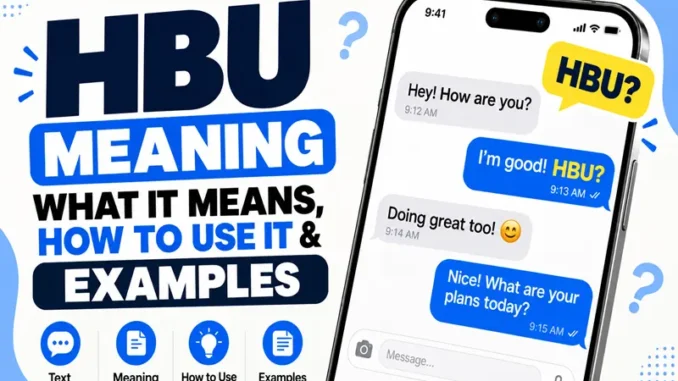
HBU stands for “How About You?” (or “How ’bout you?”). In mobile messaging, social networks, and casual online chat, HBU is a conversational initialism used to return a question, status prompt, or greeting back to the person who asked it (Crystal, 2006).
Understanding the exact HBU Meaning in text allows participants to sustain natural dialogue speed across platforms like WhatsApp, iMessage, Instagram DMs, Discord, and SMS. Rather than drafting a lengthy reply like “I am doing well, how about you?”, users rely on the shorthand to keep exchanges fluid: “Doing great, hbu?”
HBU Meaning at a Glance
| Attribute | Specification |
| Primary Expansion | How About You? |
| Colloquial Variants | How ’bout you? / How bout u? |
| Core Pragmatic Function | Reciprocal inquiry; returning a prompt to the sender |
| Linguistic Classification | Initialism (pronounced letter-by-letter: H-B-U) |
| Tone | Casual, informal, conversational |
| Primary Environments | SMS/RCS, Direct Messages (DMs), Dating apps, Gaming channels |
When evaluating what HBU means in everyday speech, linguists describe the term as an interactive volley that sustains conversational momentum (Baron, 2008). In modern digital linguistics, exploring what HBU means across varied demographics confirms that it functions as a core convention of Computer-Mediated Communication (CMC), effectively balancing minimal typing effort with social attentiveness (Crystal, 2006).
Read Also: FCFS Meaning: What Does FCFS Mean in Texting, Reselling, and Logistics?
Origins: Early Chat Protocols and SMS Constraints
Before mobile operating systems featured full QWERTY touchscreens and predictive text engines, internet shorthand emerged out of hardware constraints and carrier costs (Baron, 2008). Throughout the late 1990s and early 2000s, abbreviations like HBU spread across Internet Relay Chat (IRC), Multi-User Dungeons (MUDs), bulletin boards, and instant messengers like ICQ and AOL Instant Messenger (AIM).
Two structural constraints accelerated this adoption:
- Conversational Velocity in Multi-User Chat: Early synchronous chatrooms updated line by line in real time. Drafting complete grammatical sentences frequently caused a reply to appear out of order. Abbreviations like HBU, BRB (“be right back”), and TTYL (“talk to you later”) allowed users to maintain conversational tempo.
- The 160-Character SMS Limit: Early Global System for Mobile Communications (GSM) networks capped SMS transmissions at 160 characters (Thurlow & Poff, 2013). Because mobile carriers billed users per message block, condensing recurring phrases reduced direct consumer messaging expenses.
By the time lexicographers began indexing online speech patterns, the community consensus on what hbu means was firmly established as standard digital etiquette (Crystal, 2006).
How HBU Is Used in Everyday Messaging
In digital communication, the phrase serves as an open-ended bridge that prevents conversations from hitting a dead end. Instead of closing a thread with a one-word answer, it encourages the other participant to speak.
1. The Standard Reciprocal Greeting
The most common application occurs during routine greetings and check-ins:
- Alex: “Hey, HRU? (How are you?)”
- Sam: “Pretty good, just wrapping up some work. Hbu?”
- Alex: “Same here, clearing my inbox before the weekend.”
In this context, using hbu meaning in text applications removes social awkwardness by creating an immediate opening for the other person to share their update.
2. Dating Applications (Tinder, Bumble, Hinge)
On dating apps, mutual engagement depends on balanced effort:
- User A: “What kind of books do you usually read?”
- User B: “Mostly non-fiction and sci-fi. Hbu?”
Here, the abbreviation prevents the response from sounding self-absorbed, signaling curiosity about the match’s interests.
3. Group Channels and Community Servers
In group platforms such as Discord, Slack channels, or Reddit communities, users frequently adapt the phrase into broader variations like “hbu guys” or “hbu everyone”:
- “Just finished the final exam! hbu everyone?”
This modification turns a one-on-one phrase into an open room prompt, gathering broad responses without targeting a specific user.
Capitalization, Formatting, and Tone Nuances
Because digital initialisms lack vocal inflection and facial cues, orthography-capitalization and punctuation-determines emotional delivery (Crystal, 2006).
| Variant | Tone & Social Context | Example Usage |
| hbu? (Lowercase + Question Mark) | Standard, balanced, and polite. Fits routine personal chats. | “Quiet weekend on my end, hbu?” |
| hbu (Lowercase, No Punctuation) | Highly casual, rapid-fire typing common in mobile texting. | “just left the gym hbu” |
| HBU? (All-Caps) | High intensity, genuine surprise, or emphasis; can feel aggressive if unprompted. | “Just got the promotion! HBU?!” |
| How ’bout you? | Semi-formal spoken or typed equivalent; best when initialisms feel too curt. | “I prefer an early start. How ’bout you?” |
Stylistic Note: Sending an isolated, unpunctuated all-caps “HBU” can appear curt or dismissive in personal chats. Using lowercase (“hbu?”) or adding contextual details preserves conversational warmth.
Recommended Responses to “HBU”
How you reply should align with your relationship to the sender, your schedule, and the platform context:
| Context | Conversational Goal | Recommended Response |
| Close Friend | Share a quick, genuine status update. | “Just catching up on errands and watching a movie. Up to anything fun?” |
| Dating App Match | Share an interesting hook to keep momentum. | “Grabbing an iced matcha and exploring the local market. Know any good spots around here?” |
| Busy / At Work | Acknowledge receipt without extending the exchange. | “Deep in project deadlines today! Let’s catch up properly this weekend.” |
| Closing an Exchange | End the interaction politely. | “Shutting down my screens for the night-talk soon!” |
Real-World Contextual Dialogue Examples
Scenario A: Casual Logistics and Meetups
- Taylor: “Grabbing coffee before the study session starts.”
- Jordan: “Nice! Can you grab me an iced Americano?”
- Taylor: “Sure thing. Are you heading over now? hbu?”
- Jordan: “Walking out the door right now.”
Scenario B: Exchanging Opinions
- Morgan: “Just watched the season finale. That ending was completely unexpected.”
- Pat: “Same here, didn’t see that twist coming at all. What did you think of the pacing, hbu?”
- Morgan: “Felt slightly rushed, but the visual direction saved it.”
Usage Across Digital Platforms
While the core definition remains unchanged, formatting and application adjust across different digital spaces:
- Snapchat: Often placed as an overlay caption on photo or video snaps (e.g., a photo of a textbook captioned: “Late study session. hbu?”).
- Instagram Direct Messages: Frequently used when replying to Stories, offering an effortless, low-friction reply hook.
- Discord & Gaming Communities: Used in text channels and team lobbies to coordinate roles or equipment (e.g., “Running healer this match, hbu?”).
- SMS & RCS Messaging: Functions as an all-purpose conversational transition between family and friends.
Read Also: LMS Meaning: What Does LMS Mean in Text and Online?
HBU vs. WBU: Pragmatic and Linguistic Differences
While communicators treat HBU (“How About You?”) and WBU (“What About You?”) as interchangeable in informal speech, applied corpus linguistics identifies distinct usage patterns (Crystal, 2006; Thurlow & Poff, 2013).
| Feature | HBU (How About You?) | WBU (What About You?) |
| Primary Semantic Focus | Personal feelings, well-being, internal states. | Tangible decisions, external selections, concrete plans. |
| Optimal Context | Emotional health and casual check-ins. | Deciding schedules, dinner options, and external logistics. |
| Typical Usage | “Exhausted after that workout. HBU?” | “I want to order Italian tonight. Wbu?” |
| Linguistic Naturalness | Standard when discussing personal status. | Can sound unnatural when asking about emotional well-being. |
Practical Rule: Use HBU when checking in on internal states, emotions, or personal health (e.g., tired, energized, stressed). Use WBU when sorting through concrete choices, options, or collective plans (e.g., travel dates, restaurant choices, event tickets).
Professional Communication: Should You Use HBU at Work?
In corporate emails, external client exchanges, and formal proposals, initialisms like HBU, HRU, and LMK should be avoided (Thurlow & Poff, 2013). Unexpanded abbreviations in client-facing correspondence can undermine perceived thoroughness and professionalism.
- Client & External Inquiries: Replace initialisms with complete, polished phrasing: “How are things on your end?”, “What are your thoughts on this proposal?”, or “We would value your feedback on this draft.”
- Internal Team Chat (Slack, Microsoft Teams): Acceptable in casual direct messages or team social channels among peers who share an established working relationship. However, avoid them in company-wide channels, project kickoff briefs, or leadership updates.
Frequently Asked Questions
HBU carries no inherent romantic or gendered meaning. It simply functions as a polite conversational volley to keep an exchange going. The underlying sentiment depends on relationship context: in a late-night chat, it invites continued flirtation; in everyday exchanges, it is standard conversational manners.
The initialism itself is polite, but replying with only “hbu” and nothing else can feel low-effort or detached. Pairing the abbreviation with a specific update (e.g., “Doing well, just reading. Hbu?”) keeps the conversation engaging and warm.
HRU stands for “How Are You?” and is primarily used as an opening greeting. HBU stands for “How About You?” and is a reciprocal response that redirects the question back to the original sender.
No. HBU is an initialism designed exclusively for text-based Computer-Mediated Communication. In spoken face-to-face dialogue, speakers say the full phrase: “How about you?” or “How ’bout you?”

Leave a Reply