
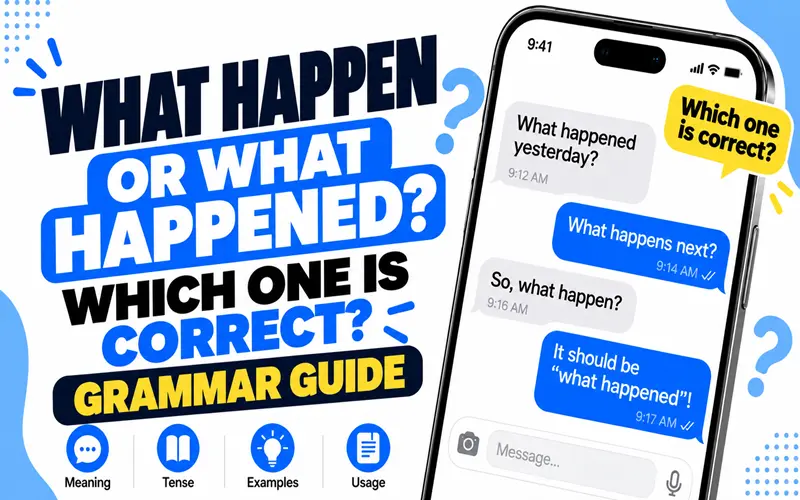
Always use “what happened” when asking about an event, action, or situation that already took place in the past. The phrase “what happen” is grammatically incomplete as a standalone question in standard English because it lacks past-tense inflection. Only use the base verb “happen” when paired with an auxiliary or modal verb (such as did, will, can, or could)-for example, “What will happen?” or “Did that happen?” (Cambridge University Press, n.d.-a).
Which Is Correct: What Happen or What Happened?
If you are evaluating whether to write what happen or what happened, the rule is straightforward: “what happened” is standard and grammatically correct.
Whenever an event concludes-whether a moment ago, earlier today, or decades in the past-the inflected past-tense form happened is required. Using the phrase “what happen” alone, without an auxiliary verb, is nonstandard in both formal writing and casual correspondence.
- Correct: “What happened to your phone?”
- Incorrect: “What happen to your phone?”
- Correct: “Tell me what happened at the meeting.”
- Incorrect: “Tell me what happen at the meeting.”
Read Also: What Does FS Mean in Text? Slang & Variations Explained
Why What Happened Is Correct: The Grammar Rule Explained
To understand why what happened is grammatically sound, consider how subject questions operate in English syntax.
In typical English question structures, an auxiliary verb like do or did carries the tense (e.g., “Where did you go?”). However, in the question “What happened?”, the interrogative pronoun “What” functions directly as the grammatical subject.
Because “What” is the subject initiating the clause, no secondary auxiliary verb (did) is required. The past-tense suffix (-ed) attaches directly to the intransitive verb happen :
Subject(What)+Past-TenseVerb(happened)=“Whathappened?”
When speakers inquire about past occurrences, the verb must explicitly reflect the past tense. Omitting the suffix produces an uninflected clause that departs from standard syntax rules.
Why What Happen Is Usually Incorrect
The phrase “what happen” is nonstandard as an independent question because the verb happen remains in its bare infinitive form without tense agreement or subject-verb inflection.
In standard English grammar:
- Past occurrences require explicit inflection: You must use the past-tense form happened.
- Present singular occurrences require the third-person marker: The correct present-tense form is what happens.
- The bare infinitive requires a helper: The verb happen cannot stand alone directly beside the subject what without an auxiliary or modal verb (Cambridge University Press, n.d.-a).
- Colloquial omission: While frequently encountered in rapid digital messaging or English as a Second Language (ESL) speech patterns, writing “what happen” alone does not conform to standard written English norms.
The “Yesterday Test”: A Quick Trick to Avoid Confusion
When deciding between what happen or what happened, apply the simple Yesterday Test:
Rule of Thumb: If you can naturally append the temporal adverb “yesterday” or “earlier” to the end of your question, you must use the past tense: “what happened.”
- Correct: “What happened [yesterday]?” (Semantically and syntactically standard).
- Incorrect: “What happen [yesterday]?” (Conflicting tense agreement).
If the action or situation has already concluded, retain the inflected form happened.
Can “What Happen” Ever Be Correct in English?
Yes, but only when preceded by an auxiliary or modal verb (Cambridge University Press, n.d.-a).
The base form happen is grammatically acceptable after what if a helping verb carries the grammatical mood or tense:
| Grammatical Structure | Example Sentence | Explanation |
| Modal (will) + happen | “What will happen tomorrow?” | Future tense is carried by the modal auxiliary will. |
| Modal (could) + happen | “What could happen if we leave early?” | Conditional possibility is marked by could. |
| Modal (might) + happen | “What might happen during the review?” | Speculation is carried by the modal might. |
| Emphatic auxiliary (did) | “What did happen in that room?” | Past tense is carried by did, leaving happen correctly in its base form. |
| Present clause | “Watch what happens next.” | Uses the third-person singular present form (happens), not bare happen. |
What Does “What Happens” Mean? (Present vs. Past)
Examining the phrase what happens clarifies when to shift away from the simple past.
While happened refers exclusively to completed historical actions, what happens employs the third-person singular present tense (-s). It serves specific linguistic functions:
- Procedural or Next Steps: “What happens after we submit our application?”
- Conditional Situations: “If the system shuts down, what happens to unsaved files?”
- Universal Facts & Natural Laws: “What happens when water reaches 100°C?”
- Recurring Processes: “What happens at the start of each fiscal quarter?”
Comparison: What Happen vs. What Happened vs. What Happens
| Feature | What Happen | What Happened | What Happens | What Will Happen |
| Grammatical Status | Nonstandard alone | Standard | Standard | Standard |
| Tense / Form | Uninflected bare verb | Simple Past | Simple Present | Simple Future |
| Time Frame | Indefinite / Missing | Completed past | Present, recurring, or condition | Future occurrence |
| Context | Requires auxiliary verb | Past events | Procedures, routines, facts | Forecasts, projections |
| Example | (Nonstandard standalone) | “What happened yesterday?” | “What happens if we delay?” | “What will happen tomorrow?” |
Why Do People Text “What Happen?” in Slang and Social Media?
In casual text messages, community chat platforms (such as Discord, Reddit, and WhatsApp), and conversational dialogue, users occasionally write “what happen?”. Several linguistic factors explain this usage:
- Phonetic Typing & Consonant Reduction: In fast colloquial speech, the final alveolar plosive sound (/d/) in happened frequently assimilates into subsequent consonant sounds or is dropped entirely (elision), leading people to transcribe words phonetically as they hear them.
- Keystroke Economy: Mobile chat users often drop grammatical inflections (-ed, -ing) to minimize typing friction.
- Cross-Linguistic Influence: Speakers of primary languages that mark temporal context using time particles rather than morphological verb inflections may naturally omit the final -ed suffix.
Texting Register vs. Professional Standards
- Casual Chat / Slang Shorthand: “bro what happen to ur car?” (Informal and phonetically transcribed).
- Professional & Academic Writing: “Could you clarify what happened during the client call?” (Standard written English).
Real-Life Examples Across Everyday Scenarios
- Inquiring About Possessions: “What happened to your laptop screen? It is cracked.”
- Personal Well-Being: “You seem surprised-what happened this morning?”
- Workplace Inquiries: “Can someone update the team on what happened during the briefing?”
- Narrating Events: “You will not believe what happened on the highway today!”
- Evaluating Procedures: “Before moving forward, let us confirm what happens when an error occurs.”
Read Also: WYF Meaning in Text: What Does It Mean? Examples & Uses
Common Grammar Mistakes to Avoid in Writing and Exams
When writing formal essays, corporate reports, or taking standardized language assessments (such as IELTS, TOEFL, or the SAT), verb tense precision is critical. Be mindful of these common traps:
- The Double-Past Error:
- Incorrect: “What did happened?”
- Correction: When the auxiliary did carries the past tense, the main verb reverts to its bare base form: “What did happen?”
- The Omitted Past Suffix:
- Incorrect: “The manager asked what happen in the lobby.”
- Correction: “The manager asked what happened in the lobby.”
- Passive Voice Confusion:
- Incorrect: “What was happened?”
- Correction: Because happen is an intransitive verb that cannot take a direct object, it cannot be rendered in the passive voice. Always write “What happened?”, never “What was happened?”.
Frequently Asked Questions
“What happened” is the correct standalone phrase. It uses the simple past tense to ask about an event that concluded previously. The phrase “what happen” is grammatically incomplete without a supporting auxiliary verb.
Standing alone as an interrogative sentence, “what happen” is not standard English. It requires an auxiliary verb (e.g., “What did happen?”, “What will happen?”) or appropriate tense inflection to be grammatically standard (Cambridge University Press, n.d.-a).
Yes. “What did happen” is grammatically correct and functions as an emphatic construction. For example: “Rumors circulated quickly, but what did actually happen?” Here, the auxiliary did carries the simple past tense, keeping happen in its bare infinitive form.
The distinction is based on grammatical tense and time frame:
1. What happened refers to a completed past event (“What happened at the meeting?”).
2. What happens uses the third-person simple present tense to address recurring routines, general scientific principles, or conditional next steps (“What happens when you boil water?”).
English syntax avoids double past-tense marking within the same verb phrase. Because the auxiliary verb did already establishes the past tense, the following main verb must stay in its bare infinitive form (happen).
The correct phrasing is always “what happened to you?” Inquiring with “what happen to you?” omits the necessary past-tense suffix.